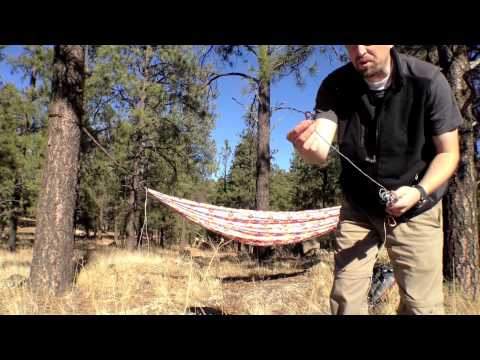
Video: Using Continuous Ridge Lines with a Tarp

Here are two quick video segments demonstrating continuous ridge lines with a tarp. The first video is a live example of what I illustrated in my book, and elsewhere,  using two carabiners. The second video is a new method that I really like that uses one DutchWare Dutch Hook and one DutchWare Tarp Flyz (or Stingerz). Both methods link the ridge line into a sort of figure-8 loop that allows the tarp to slide back and forth easily so it can be centered over your hammock.

Read more: Knots vs. Hardware

I have illustrated several ways to tie up a tarp using hardware or no hardware and you’re probably wondering, “but which is the best way?” or “why not stick with just one?” For me, I enjoy having these different methods in my tool box depending on the situation. The no knot methods are important in case I’m left in a situation where that’s all I’ve got to work with. I really like the simple Dutch Hook/Tarp Flyz (or Stingers) method illustrated below because it is lightweight and the Dutch Flyz provides that mechanical advantage (similar to a Trucker’s Hitch knot) to tension the tarp close to the ridgline. I’ve found that Prusik knots tend to jam or get stuck on the line and can be difficult to tighten or loosen (especially when it gets cold).

Enjoy!

A Continuous Ridge Line for a Tarp using Two Carabiners

continuous-ridgeline-dutch-hook

Categories: , ,

Leave a Reply to Gabe Cancel reply

Your email address will not be published. Required fields are marked *

This site uses Akismet to reduce spam. Learn how your comment data is processed.

75 responses to “Video: Using Continuous Ridge Lines with a Tarp”

  1. Lauren Avatar
    Lauren

    Hi, Derek –

    Thank you so much for the all of the great information. There’s a lot of helpful dialogue here. Sorry to pile on to the thread so long after the last post, but I have a novice question that I don’t think has been addressed. Why do you splice the carabiner on the one end (via the larkshead knot)? Isn’t there a way to add the carabiner to that end without having to splice? I am a bit confused on that point and fear missing something critical by not understanding.

    I’ll be taking my first hammock camping trip up to the Apostle Islands (Wisconsin) and stumbled upon your website. Looking forward to trying it out and hoping I won’t need to use the tarp, but wanting to be prepared just in case. If the trip goes even remotely well, I’ll check out your books. I was surprised to learn that you also illustrated them, and very beautifully. You’re amazing!

    Best wishes to you!

    Lauren

    1. Derek Hansen Avatar

      You’re right that you don’t need to splice it in, especially the carabiner. I think that is just a way of talking about the two ends.

  2. David Avatar
    David

    It’s a nice versatile/quick system, I like it. As a knot enthusiast and UL minimalist, I always enjoy the ‘puzzle game’ of trying simplify and reduce components – you can do all this with a single cord, dropping from 4 components down to 1.

    The knot equivalent of a carabiner is a soft shackle, so you could replace the carabiners with an alpine butterfly and Ashley stopper at the cord ends. Then in place of the Prusik, you could use a Blake’s hitch (thread-thru-center method) as a inline/midline tensioner, which puts off the slack into a side loop. Give me a holler if you’re interested.

    1. Derek Hansen Avatar

      I like your methodology and keeping things simple — speaks to my heart! More often, I don’t use a continuous ridgeline because it adds hassle and components that aren’t needed. More often I just use line tied to the end of each side of the tarp. No additional hardware, less rope needed.

  3. Gabe Avatar
    Gabe

    Hi! I’m super late to this. I was just wondering about how long my continuous ridgeline should be?

    1. Derek Hansen Avatar

      I would start with twice as long as your tarp ridgeline.